
How to Reduce Home Loan Tenure by Increasing Your EMI
Adding ₹3,000/month to your EMI on a ₹50L loan can close it nearly 3 years early and save ₹7+ lakhs. Here is exactly how to calculate the benefit and make the request to your bank.
Last updated: Published 16 May 2026 · Updated 25 May 2026
Published 16 May 2026 · Updated 25 May 2026
EMI increase vs part-prepayment: what is the difference?
When your income increases — salary hike, rental income, a new source — you may want to direct more money toward your home loan. You have two main levers: formally request a higher EMI (tenure reduction), or simply make additional part-prepayments whenever you have surplus.
A formal EMI increase changes your standing instruction with the bank. The new (higher) EMI is debited every month automatically. You need to request this formally and your lender will issue a revised sanction or schedule.
An extra part-prepayment is more flexible — you pay extra when you can, as a lump sum, but your regular EMI does not change. This is often easier and more flexible for most borrowers, but requires more discipline to execute consistently.
How much does increasing your EMI save?
The interest savings from a higher EMI depend on how much you increase it, how early in the loan tenure you make the change, and your current outstanding balance.
| Monthly EMI increase | Loan: ₹50L at 8.5%, 20yr remaining | Interest saved | Tenure reduced |
|---|---|---|---|
| ₹1,000/month | ₹43,391 → ₹44,391 | ~₹3.2L | ~12 months |
| ₹2,000/month | ₹43,391 → ₹45,391 | ~₹5.8L | ~22 months |
| ₹3,000/month | ₹43,391 → ₹46,391 | ~₹7.9L | ~31 months |
| ₹5,000/month | ₹43,391 → ₹48,391 | ~₹11.8L | ~47 months |
These figures are illustrative. Your actual savings depend on your outstanding principal, current rate, and remaining tenure. Use KlearPay to calculate your exact saving before approaching your bank.
One key insight from the table: even a modest ₹2,000/month EMI increase on a ₹50L loan saves nearly ₹6 lakhs and closes the loan almost 2 years early. The compounding effect of earlier principal reduction is significant.
How to formally request a tenure reduction (EMI increase)
The process for formally increasing your EMI and reducing tenure typically involves:
- Write a letter or submit a digital request to your home loan servicing branch or relationship manager, stating that you want to increase your EMI amount and reduce your remaining tenure accordingly.
- Your lender will prepare a revised amortisation schedule reflecting the higher EMI and shorter tenure. Review it carefully — confirm the new end date matches your expectation.
- Update your standing instruction (auto-debit mandate) to the new higher amount. Some banks require a fresh NACH mandate; others can change it internally.
- No charge applies for this request on floating-rate loans — lenders cannot charge for tenure restructuring at the borrower's request.
Some lenders allow this change digitally through their apps; others require a branch visit. See the bank-wise process below.
Bank-wise process for requesting EMI increase
| Bank | Digital option? | Contact for EMI increase |
|---|---|---|
| HDFC Bank | MyLoan portal / call 1800-11-2211 | Preferred: MyLoan portal or relationship manager |
| SBI | YONO / branch | Visit branch with written request or YONO request |
| ICICI Bank | iMobile Pay / 1860-120-7777 | Contact customer care or submit a service request in iMobile |
| Axis Bank | Axis Mobile / branch | Submit a service request via Axis Mobile or branch |
| Kotak Mahindra Bank | Kotak app / branch | Contact Kotak home loan servicing via app or branch |
| LIC Housing Finance | Branch (limited digital) | Written request at servicing branch |
| PNB | PNB ONE / branch | PNB ONE app service request or branch visit |
| Canara Bank | Canara AI1 / branch | Branch visit with written request recommended |
After the EMI change is processed, verify on your next statement that the new amount is debiting correctly and that the revised end date matches the schedule issued by the bank.
When to increase your EMI: the best timing
The earlier in your loan tenure you increase the EMI, the more you save — because more of your loan has interest-heavy early EMIs where the principal is high. The benefit diminishes as you approach the end of the loan.
Good triggers for an EMI increase:
- Annual salary increment: allocate a portion of the increment (e.g., 30–50% of the monthly take-home increase) toward a higher EMI.
- After a major household expense is paid off (car loan, children's school fees, renovation): redirect that freed-up cash to the home loan.
- Interest rate increase by RBI: if your floating-rate EMI rises, consider absorbing it voluntarily rather than requesting a tenure extension.
One caution: do not increase your EMI to the point where you have no emergency fund. Maintain at least 6 months of expenses liquid before putting extra money toward the home loan.
The easier alternative: regular extra prepayments
If your lender's EMI change process is cumbersome, or if your income is variable, you can achieve the same effect through regular extra prepayments instead of a formal EMI revision.
Example: instead of formally increasing your EMI by ₹3,000, simply transfer ₹3,000 extra toward your loan account every month as a part-prepayment. The interest savings over time are nearly identical.
The advantage: flexibility. You can prepay ₹3,000 in good months and skip it if you have an unexpected expense. A formal EMI increase locks you into a higher mandatory payment every month.
The disadvantage: it requires discipline. Without an auto-debit for the extra amount, many borrowers skip the extra payment when other expenses come up. A formal EMI increase ensures consistency.
KlearPay helps you plan and track both approaches. See monthly vs yearly prepayment comparison for a side-by-side analysis.
Frequently asked questions
Recommended articles
Complete Guide · 2026
Home Loan Prepayment Guide India 2026
Everything you need to know about prepaying your home loan in India, including when to start, how much interest you can save, and how to decide between prepayment and investing.
લેખ વાંચોPrepayment Strategy
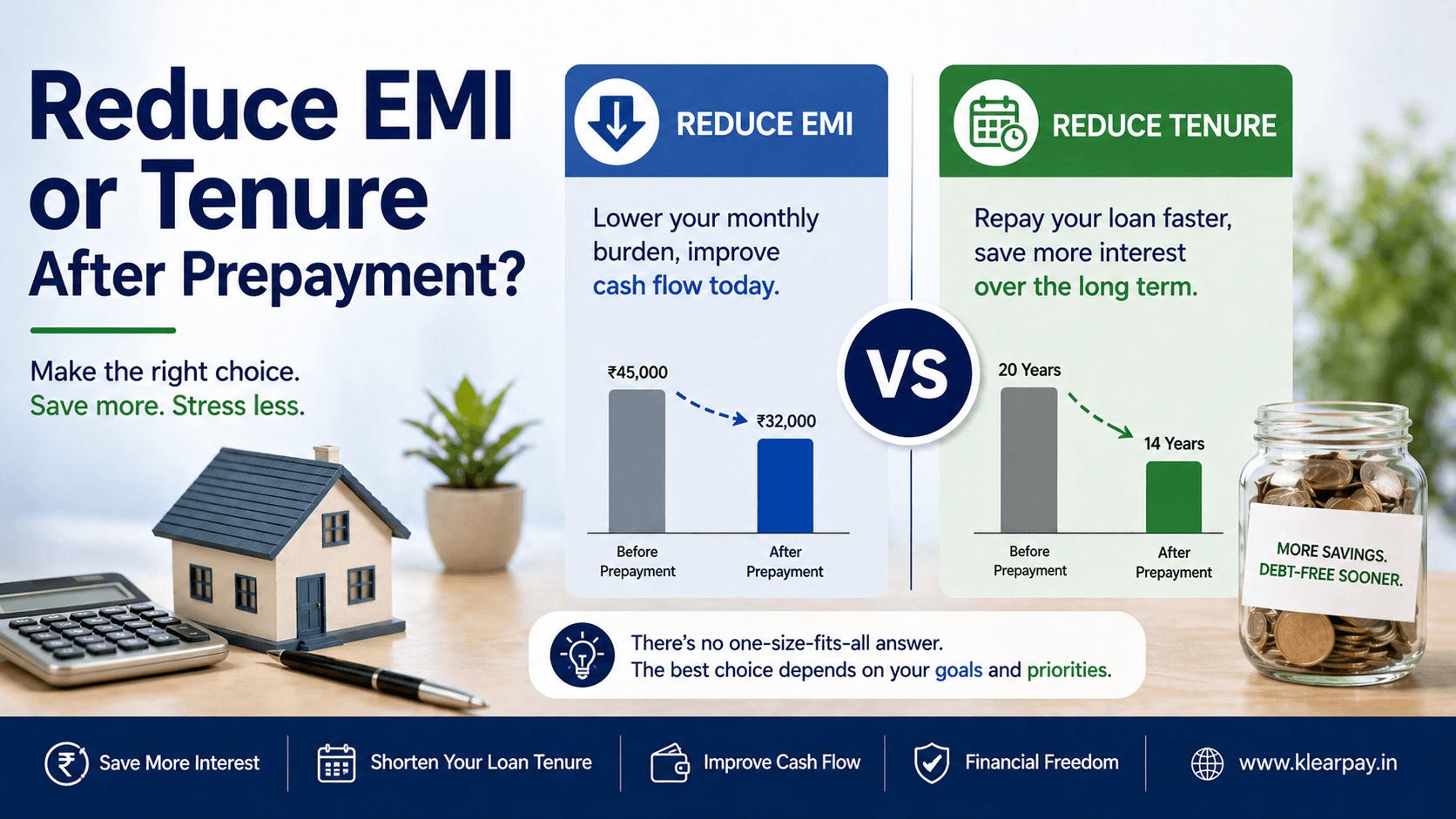
Reduce EMI or Tenure After Home Loan Prepayment?
Your lender will ask: reduce EMI or tenure? Here is exactly which option saves more and when to choose each.
લેખ વાંચોPrepayment Strategy
Monthly vs Yearly Home Loan Prepayment: Which Saves More?
Monthly ₹5,000 prepayments vs a single ₹60,000 lump sum yearly: which saves more interest on your home loan?
લેખ વાંચોહજારો સ્માર્ટ ઉધારકર્તાઓ સાથે જોડાઓ
₹12.45L+
વ્યાજ બચત
500+
સક્રિય વપરાશકર્તાઓ
30 સેક
સરેરાશ વિશ્લેષણ સમય